
1. Growing Seasons
In the northern provinces of Vietnam, there are three main cabbage growing seasons:
– Early crop: Sow seeds in late July to early August, transplant in late August and September for harvest in November and December.
– Main crop: Sow in September–October, transplant from mid-October to the end of November for harvest in January–February of the following year.
– Late crop: Sow in November, transplant in mid-December for harvest in February–March of the following year.
2. Soil Preparation and Fertilization
Apply 20–25 tons/ha of well-decomposed manure (composted for at least 3 months before use. Add 20 kg of lime and 25 kg of superphosphate per ton of fresh manure during composting). If using organic bio-phosphate fertilizer, apply 250–300 kg/ha. With this amount, manure can be reduced to 15–20 tons/ha.
To achieve high yields and maintain nitrate content below 500 mg/kg, apply per hectare: 120–150 kg N for the early crop (260–325 kg urea)
; 150–180 kg N for the main and late crops (260–390 kg urea)
If using organic bio-phosphate, add 60 kg P2O5 (300 kg superphosphate); otherwise, apply 90 kg P2O5 (or 180 kg superphosphate). Required potassium per hectare is 120 kg K2O, preferably in sulfate form.
Basal fertilization includes all manure + bio-phosphate + 1/2 potassium + 1/4 nitrogen. There are two methods of basal fertilization: Evenly spread before bed preparation; Apply in planting holes after bed preparation. If using the second method, mix well and cover before transplanting.
3. Topdressing is done in 3 stages:
- Recovery stage: Apply the remaining potassium + 1/3 remaining nitrogen. Method: Apply around the base and lightly till.The remaining nitrogen is split in half and diluted in water for root watering in the following stages:
- Leaf expansion stage: 30–35 days after transplanting.
- Head formation stage: 45–50 days after transplanting.
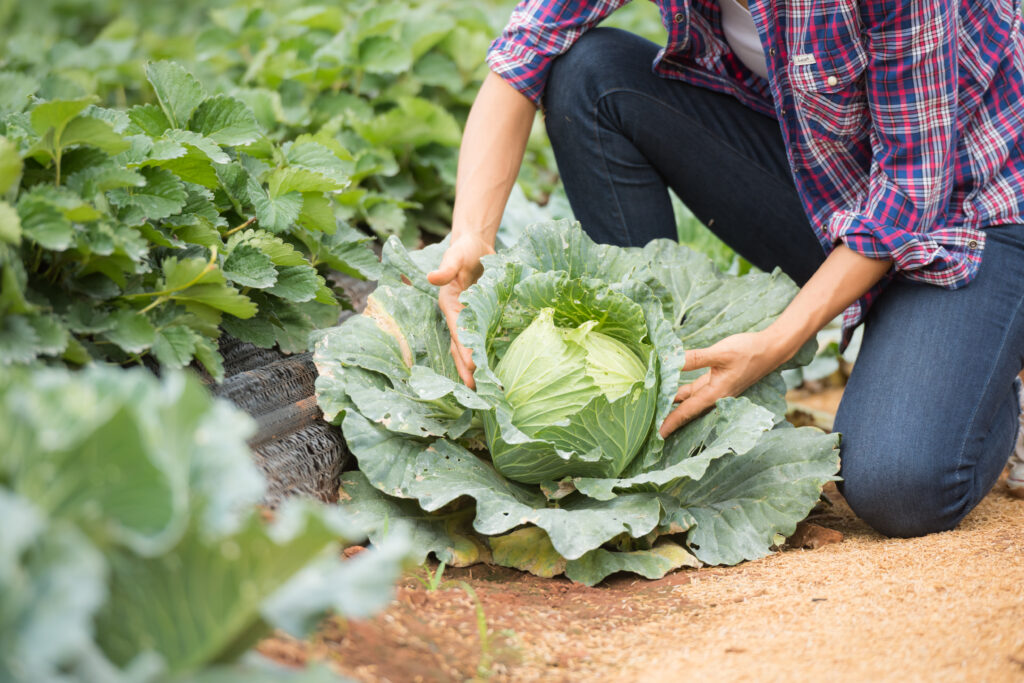
Choose healthy, sturdy, uniform seedlings and transplant in the afternoon (if sunny and dry). Before transplanting, dip the roots in a 0.1–0.15% Sherpa solution. If using polyethylene mulch, cover the bed after basal fertilization, secure the edges, and make planting holes.
Plant in double rows in a staggered (zigzag) pattern on the bed. Depending on head size and crop season, use the following spacing:
– Early and late crops: 50 x 40 cm
– Main crop: 50 x 50 cm
After transplanting, water thoroughly, then water daily until plants establish. After the first topdressing, trench irrigation can be applied. Ensure water reaches two-thirds of the bed height and fully drains after irrigating. Avoid trench irrigation before and after rainfall. Use clean water free from contamination. Absolutely avoid using fresh manure water for irrigation.
In the early stages, when cabbage plants are still small, intercrop with lettuce, mustard greens, or other short-duration crops (under 30 days). In the main crop, tomatoes can be intercropped at a ratio of one tomato bed for every two cabbage beds. This method significantly reduces the third-generation diamondback moth population.